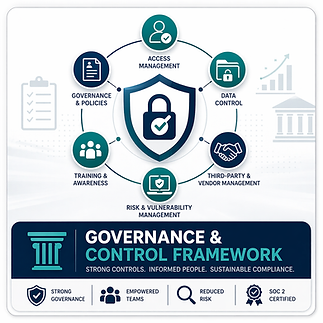
THE GOVERNANCE & CONTROL FRAMEWORK
Scaling Compliance, Access, and Risk Management Across the Enterprise
Designed and implemented a comprehensive governance and control framework to strengthen the organization’s compliance posture, support SOC 2 certification, and establish scalable oversight across access management, data control, third-party systems, and vendor relationships.
This initiative extended beyond policy development to include training, enablement, and adoption, ensuring that governance was not only defined, but understood and consistently executed across the organization. The result was a fully integrated governance ecosystem that improved accountability, reduced risk exposure, and enabled successful audit outcomes.
Context
As the organization operated within a regulated payments environment, there was increasing pressure to formalize internal controls, strengthen documentation, and align operational practices with SOC 2 and PCI expectations.
Critical governance areas including employee access, third-party applications, vendor oversight, and data control required greater structure and consistency. Existing processes were often informal or inconsistently applied, creating gaps in accountability, audit readiness, and risk visibility.
In addition, there was a clear need to ensure that employees not only had access to governance policies, but also understood how to apply them in their day-to-day responsibilities. Without training and enablement, policy adoption would remain inconsistent.
This created the need for a holistic governance ecosystem that combined policy, process, and education.
Objective
To design and implement an integrated governance framework that would:
-
Strengthen internal controls across access, data, vendor, and third-party systems
-
Support and enable successful SOC 2 certification
-
Standardize ownership, accountability, and review processes
-
Reduce ambiguity in employee lifecycle and system access management
-
Ensure employees were trained and equipped to follow governance practices
-
Align compliance expectations with real-world workflows
-
Create a scalable foundation for ongoing governance, audit readiness, and organizational growth
Strategy & Approach
-
This initiative was approached as a full governance enablement model, not just a policy effort.
-
Identified core governance domains: access lifecycle, data control, third-party systems, and vendor management
-
Translated informal practices into structured, repeatable governance models
-
Aligned policies with SOC 2 and PCI expectations while maintaining operational usability
-
Integrated cross-functional responsibilities across HR , IT, and operational teams
-
Standardized terminology, ownership, and review cadences across policies
-
Built connections between policies to create a cohesive governance ecosystem
-
Designed and developed training programs and supporting materials to drive awareness and adoption
-
Ensured governance processes were embedded into workflows, not treated as separate compliance activities
Key elements of the strategy included:
-
1. JML Access Lifecycle Model
Structured onboarding, role change, and offboarding processes to ensure proper access provisioning, deprovisioning, and audit tracking.
-
2. Data Access & Control Framework
Defined data access governance, ownership, review cadence, and enforcement mechanisms.
-
3. Third-Party Application Access Review Model
Established access review structures, application tiering, and exception handling for external systems.
-
4. Vendor Governance Framework
Implemented vendor tiering, onboarding protocols, risk evaluation, and monitoring processes.
-
5. Vulnerability Management Program
Aligned vulnerability tracking and remediation with compliance and audit expectations.
-
6. System & Tool Inventory Alignment
Documented system ownership, access risks, and integration dependencies.
-
7. Governance Training & Enablement Program
Developed and delivered training materials, guidance, and resources to ensure employees understood and could apply governance policies effectively in their roles.
Anticipated Risks & Mitigation Strategy
-
Risk: Policies not adopted in practice
Mitigation: Developed and delivered targeted training to ensure understanding and real-world application
-
Risk: Fragmented control environment across departments
Mitigation: Standardized governance structures and aligned policies into a unified system
-
Risk: Misalignment between IT and internal operations
Mitigation: Clarified shared ownership and cross-functional responsibilities
-
Risk: Audit gaps due to incomplete or misunderstood processes
Mitigation: Strengthened documentation and reinforced expectations through training and communication
-
Risk: Compliance fatigue or resistance
Mitigation: Positioned governance as an operational enabler and supported adoption through education
Key Solutions & Innovations
-
Transformed policy work into a connected governance and enablement ecosystem
-
Built a comprehensive access lifecycle model (JML) integrating HR, IT, and operations
-
Introduced structured oversight for vendors and third-party applications
-
Established repeatable governance processes and accountability mechanisms
-
Integrated governance with training and awareness, ensuring adoption across teams
-
Bridged the gap between compliance requirements and real-world execution
-
Positioned governance as a sustainable operational system, not just documentation
Results & Impact
-
Successfully supported and contributed to the organization achieving SOC 2 compliance certification, validating both governance design and execution
-
Established a scalable and cohesive control environment across access, data, vendor, and third-party systems
-
Improved clarity of ownership, accountability, and access lifecycle management across HR, IT, and operational teams
-
Increased adoption of governance practices through training and enablement, ensuring employees understood and applied policies consistently
-
Reduced governance ambiguity by transforming fragmented policies into a unified, interconnected system
-
Enhanced visibility into system access, vendor relationships, and data control practices, strengthening risk management
-
Created a sustainable foundation for ongoing compliance maturity, audit readiness, and organizational growth
Leadership Takeaway
Compliance is not a milestone, it is an operating system. When governance is designed, taught, and embedded into daily work, organizations don’t just pass audits,they perform with consistency and control.