RAPID CRM TRANSITION & OPERATIONAL CONTINUITY INITIATIVE
Designing a 14-Day Enterprise Transition Plan Under High-Stakes Business Constraints
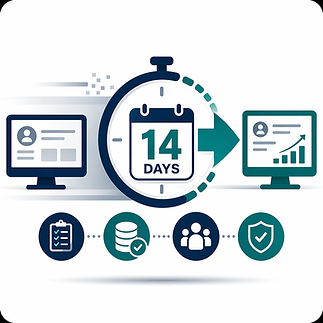
Led the development of a high-impact, time-sensitive transition strategy to move the organization from one CRM platform to another within 14 days due to external business decisions outside of the company’s control. This initiative required rapid planning, risk assessment, data and access coordination, learning enablement, and operational continuity support to ensure the business could navigate the change without significant disruption.
Rather than treating the transition as a simple technology handoff, the effort was approached as a compressed enterprise change initiative requiring coordination across systems, data, employees, administrators, and client-facing processes. The result was a structured transition runway designed to preserve critical operational knowledge, reduce migration risk, and prepare teams to function effectively in a new environment under an accelerated timeline.
Context
The organization was required to move from an existing CRM platform to a new one within a 14-day window, creating a high-pressure scenario with limited time for transition planning, user preparation, data extraction, and process continuity. The speed of the required shift introduced multiple layers of operational risk, including disruption to team workflows, loss of critical data, inconsistent access, training gaps, and downstream impact on client interactions.
Because the CRM environment touched multiple departments and supported important business processes, the transition could not be approached as a purely technical migration. Existing documentation, frameworks, process knowledge, and administrative structures had to be quickly reviewed and leveraged to identify what needed to be preserved, what gaps existed, and where vulnerabilities might emerge during the transition.
This created the need for a structured, fast-moving transition plan that balanced urgency with rigor.
Objective
To design a comprehensive 14-day transition plan that would support a rapid CRM platform migration while minimizing operational disruption, protecting critical data and workflows, and preparing employees to successfully navigate the change.
Specific objectives included:
-
creating a structured transition runway under an accelerated timeline
-
identifying high-risk areas, dependency points, and potential workflow breakdowns
-
preserving critical operational and client-related data during the transition
-
ensuring key team members had the access needed to support extraction, transfer, and cleanup activities
-
assessing how existing workflows and training materials would map to the new platform
-
equipping employees with the learning and support needed to adapt quickly
-
providing recommendations to support implementation and reduce avoidable errors
Strategy & Approach
-
This initiative required balancing speed with control. The strategy centered on using the short runway as effectively as possible by combining risk assessment, systems analysis, learning enablement, and stakeholder coordination into one integrated transition effort.
Key elements of the strategy included:
-
Building a 14-day transition plan structured around urgent priorities, dependencies, and implementation readiness
-
reviewing existing CRM documentation, workflows, and supporting frameworks to identify what processes, data structures, and controls needed to be preserved or rethought
-
analyzing gaps, risks, and vulnerable points that could affect internal operations, client interactions, or team readiness during the migration
-
researching the incoming platform to understand how core functions, fields, workflows, and user needs would map in the new environment
-
identifying critical data points requiring export, retention, or special attention prior to removal or migration
-
coordinating with administrators and relevant stakeholders to confirm appropriate access levels for essential personnel supporting bulk data activity, removal, and transition execution
-
developing learning and readiness considerations to help employees adapt to the platform change and reduce confusion during go-live
-
formulating implementation recommendations to support smoother adoption, reduce disruption, and strengthen continuity during the compressed migration window
-
This approach allowed the transition effort to function not only as a project plan, but as a rapid response operating model for change under pressure.
Anticipated Risks & Mitigation Strategy
-
Risk: Critical data loss during transition
Mitigation: Identified essential data points for export and preservation, validated access requirements, and emphasized retention of high-value operational information prior to migration activity.
-
Risk: Recreating confusion or inefficiency in the new platform
Mitigation: Reviewed legacy documentation and workflow structures to identify gaps, dependencies, and future-state considerations rather than treating the move as a simple system swap.
-
Risk: Employees unprepared to work in the new environment
Mitigation: Incorporated learning and readiness planning into the transition effort so employees would be better equipped to navigate the platform change.
-
Risk: Business disruption caused by compressed timelines
Mitigation: Structured work into a focused 14-day runway with prioritization around the most critical dependencies, decisions, and actions.
-
Risk: Inadequate administrative access delaying transition activities
Mitigation: Coordinated with administrators and peer experts to clarify access needs and ensure essential personnel had the permissions required for key transition tasks.
-
Risk: Client-facing impact due to workflow or communication breakdowns
Mitigation: Assessed vulnerable points affecting client interaction and considered continuity needs in the transition recommendations.
Key Solutions & Innovations
-
1. Built a 14-day transition runway under tight time constraints
Created a time-bound strategic plan to guide a high-stakes platform transition with enough structure to support execution under constrained conditions. -
2. Leveraged existing documentation as migration intelligence
Used prior CRM frameworks, documents, and process structures as a rapid diagnostic tool to identify critical dependencies, risks, and continuity requirements. -
3. Combined systems transition with change readiness
Recognized that success depended not only on moving data, but on preparing employees to operate effectively in a new environment. -
4. Elevated risk identification as a core transition function
Analyzed vulnerable points related to workflows, access, client interactions, and operational continuity to strengthen the overall migration approach. -
5. Researched future-state mapping proactively
Investigated how the new platform would align to business needs and legacy structures, helping inform smarter transition recommendations. -
6. Coordinated access and administrative clarity
Worked across stakeholders to confirm what permissions and roles were needed to support extraction, mass data handling, removal, and migration-related tasks. -
7. Protected continuity amid compressed timelines
Positioned the transition as an operational continuity effort, not just a system replacement, helping the business maintain focus on function as well as speed.
Results & Impact
-
Successfully executed a full CRM platform migration within a 14-day timeframe, meeting urgent business requirements under compressed conditions
-
Achieved transition with minimal operational disruption, maintaining continuity across internal workflows and client-facing processes
-
Developed and implemented a structured transition plan that enabled the organization to move quickly while maintaining control over key dependencies
-
Identified and addressed critical risks, gaps, and vulnerable points prior to migration, reducing the likelihood of downstream issues
-
Ensured preservation and handling of essential data and operational context, supporting continuity during and after transition
-
Strengthened cross-functional coordination by aligning administrators, stakeholders, and operational teams around access, data, and execution priorities
-
Integrated employee readiness and learning considerations into the transition approach, helping teams adapt more effectively to the new platform
-
Reinforced the organization’s ability to manage high-stakes, time-sensitive system changes with structure and strategic oversight
Leadership Takeaway
The true test of systems leadership is not managing change when time is abundant. It is creating clarity, continuity, and control when the transition window is measured in days.